|
|
| |
|
| Physics Dept. Site Map | |
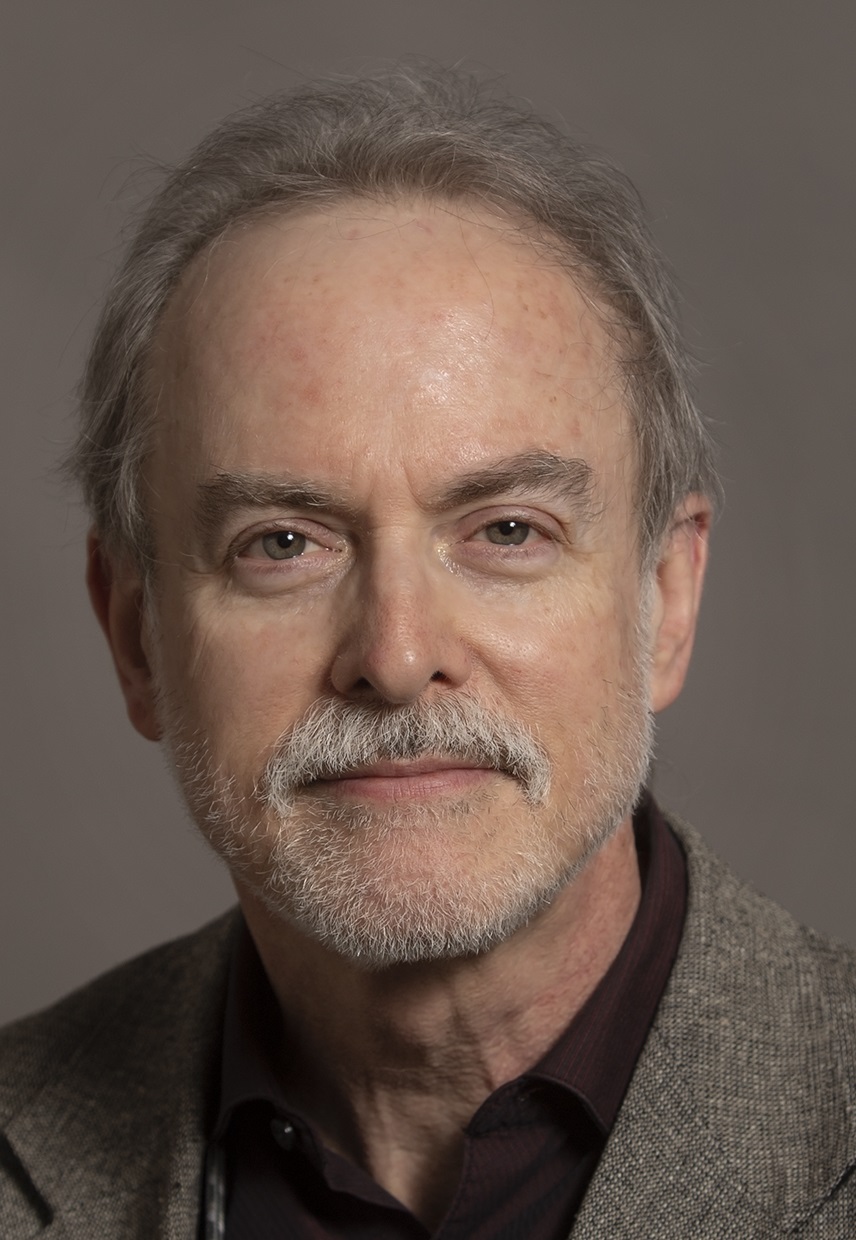 Photo: Tara Freeman. My Curriculum vitae My professional genealogy |
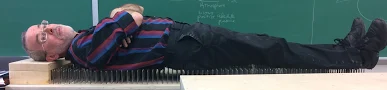
Daniel Warren Koon arrived at St. Lawrence 35 years ago, fresh from graduate school, and immediately baked some of the newly-discovered high-temperature 'YBCO' superconductor before his first classes started. He has taught every course in the Physics major, along with several introductory lectures and labs for non-physicists and non-scientists, and a couple upper-level special topics. He designed the interdisciplinary distribution course, "Energy", which he has taught for over twenty years. He has pioneered the studio format, in which lecture and lab are taught together, a format still in use in the department. He directed the department's Microwave Optics Symposium for about 25 years since its beginning. Daniel has also taught several science-fiction based courses in the First Year Program, summer classes at Clarkson, adult classes for SOAR, and a laboratory section in Costa Rica in Spanish, plus he has taught the kinematics of projectile motion to one future starting NFL quarterback. He won an NSF award with which he bought the department's first optical breadboards, optical table, and modern mounting hardware. In the classroom Daniel enjoys a good demonstration, blowing liquid-nitrogen-vapor "smoke rings", lying on the department's homemade bed of nails, or getting students to "refract" through a "lens" in the hallway.
Daniel's research has mostly been in the field of materials science, particularly electrical measurements like the Hall effect, a measure of electric current's deflection in a magnetic field. It is a small effect, requiring sophisticated techniques to tease out. Daniel has spent sabbatical years at the University of New Mexico, the University of Costa Rica, the Autonomous University of Madrid, and the University of Chemistry and Technology in Prague. He has been awarded two Fulbrights: one to the Technical University of Berlin and the other to Prague. During his sabbaticals he has designed upconversion fiber lasers, measured the Hall effect in metals as they absorb hydrogen (a phenomenon of interest for energy applications), and studied the effect of local impurities on resistive and Hall measurements. In addition, he has gained some notoriety for shooting down two scientific urban myths: first, that polar bear hairs act as light pipes, channeling ultraviolet light to their skin, and second, that the iridescence of butterflies and other insects acts as a solar collector. (In fact, it is a sunblock.) He has directed SLU senior student projects in all of these and other topics, co-authoring scientific papers with students. His Erdös number is 4 and his h index is 15. Daniel is internationally known for his translation of Spanish-language science fiction stories, particularly by Cuban authors. Daniel only first started learning Spanish at age 39 while working full-time at St. Lawrence, but has translated dozens of stories, both online and in print. He looks forward to having more time for book-length translation projects in his retirement, and to traveling with his wife, Judy, while together they patiently explain to their hosts that there are no skyscrapers in Canton, New York. |