|
Van der Waals bond, covalent, ionic, hydrogen, metallic. Madelung constant ideal crystal basis Bravais (space, plane) lattice unit cell |
point group plane group (real lattice) cubic lattice (cubic primitive) tetragonal lattice orthorhombic lattice BCC |
FCC HCP reciprocal lattice Brillouin zone vacancy interstitial |
|
phonon vibrational waves dispersion relationship group velocity phase velocity |
density of [phonon] states acoustic branch optical branch Einstein [characteristic] temperature Debye [characteristic] temperature |
lattice specific heat electronic specific heat phonon mean free path phonon scattering |
|
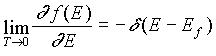
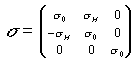
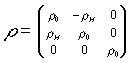
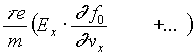
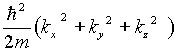
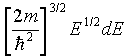
Classical free electron theory: (CFE) fo µ exp(-b Ek) <Ek> = Drude Model: Scattering caused by the positive ions Survival probability: n=noe-t/t s = ne2t / m Celn » Clattice Lorentz Model: CFE using Boltzmann ea.: f = f0 + ![]() RH = -1.18/ne Magnetoresistance: r = r o + M B2 Quantized free electron theory: (QFE) E = Density of states: g(k) dk = (k/p )2dk g(E)dE = Fermion statistics: Significance of the Fermi Energy Ef0 = Sommerfeld model: (QFE & Boltz. eq.) Celn = g T » (kT/Ef) Clattice |
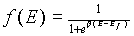
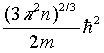
g
= (p
2k2/3 ) g(Ef)
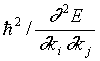
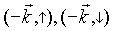
Pauli Paramgnetism: c µ g(Ef), c » (kT/Ef) c class s = [ne2t (Ef)]/m RH = -1/ne l >> than for Drude, Lorentz (Defects, phonons cause electron scattering.) Band Theory: Bloch functions Kronig-Penney model Band gaps Fermi surface Brillouin zones (again!) k-space, inverse or momentum space Connection between Brillouin zone boundaries and energy gaps Effective mass, mij= Holes Superconductors Organic, heavy fermion, cuprate Zero resistance Persistant current Meissner effect Type I, Type II superconductors Flux quantiz.: Heat capacity 'glitch' Tuyn's law. Hc = H0[1-(T/Tc)2] BCS. electron-phonon coupling BCS. density of states in SC BCS: Cooper pairs: Electromagnets, Josephson junctions, SQUIDS, etc. |
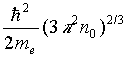
|
Be able to sketch density of states, g(e
) and Fermi filling factor, f(e
). Impurities: e d = Ry(mc/me)(1/k2), ad = a0k (me/mc) Metal-Insulator Transition: nc1/3ad @ 1/4 Law of Mass Action: Na- + n = Nd+ + p Degenerate: e F = e c + ![]() Classical: e F = e c - kTln(Nc/n0) ni µ T3 exp(-e g/2kT) Intrinsic: n@ ni Saturation: n@ Nd - Na Freezeout: n = [Nc(Nd - Na)/NakT] exp (-e d/kT) Conductivity: s = nem e + pem h Hall coeff.: RH = (S Ris i2/[S s i]2) ® (1/ne)(<t2>/<t>2) tan q H = r xy/r xx = w ct = RHs B Be able to sketch impurity and conduction bands as N® Nc. Be able to explain why impurity bands broaden. |
Phop µ
exp[-2a
R-b
D
E] 3D Variable-range hop: s µ exp[-(T0/T)1/4] Be able to sketch g(e ) for amorphous semis. ![]() ![]() r 0 = s 0 / (s 02 + s H2) r H = s H / (s 02 + s H2), etc. Cyclotron resonance: w c = eB/m* Quantum Hall Effect: r H = h/n e2 = 25812W /n Be able to sketch reciprocal lattice for a fcc space lattice. Be able to point out the gross features of the reciprocal space of Si, Ge, and describe location and number of equivalent valleys. Additional definitions: extrinsic semiconductor compensation Seebeck effect Phonon-assisted hopping Fractional Quantum Hall Effect Indirect electronic transitions |
|
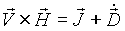
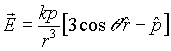
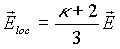
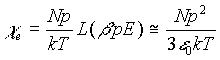
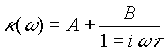
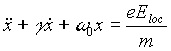
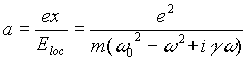
Miscellaneous E&M e 0 = 8.85 ´ 10-17F/m m 0 = 4p ´ 10-7H/m Dipole field: ![]() Kramers-Kronig: ![]() ![]() Dielectrics: Atomic polarizability: ![]() Clausius-Mosotti: S Njaj=3e 0 Perm. dipoles: Langevin function: L(w) = coth(w)-(1/w) ® (w/3) (t
=1/w
0)Ionic and Electronic polarization: ![]() Piezoelectricity Electrostriction Ferroelectricity |
Magnetism: Magnetic moment: Bohr magneton : 9.27´
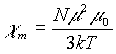
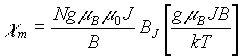
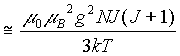
10-24J/Tg = Lande splitting factor Atomic angular momentum: Diamagnetism: ![]() Paramagnetism: Curie Law: ![]() Quantum mech. ® Brillouin fctn: BJ(y) = ![]() ![]() Antiferromagnetism Neel temperature Ferrimagnetism Spin waves, magnons Exchange integral, Uij = -2Je Magnetic domains Electron spin resonance n [GHz) = 14.00 g B[T]; g = 0.0715n /B Spin-lattice & spin-spin relaxation Nuclear magnetic resonance: n [MHz] = 7.623 gnB[T] Protons: m = 2.793 m n Neutrons: m = -1.913 m n Negative temperature |