Five examples might include representing a 1) directory structure, 2) a family tree, 3) an HTML document, 4) arithmetic expressions, 5) data with an ordering (a binary search tree)
An expression tree
If we have data that should be ordered on some key value (i.e., last name, SSN, etc.) so we have fast access, inserts and deletes.
We talked extensively in class about this.
find method for a binary search tree.
	public E find(E data) {
	  return find(data, root);
	}

	private E find(E data, Node<E> root) {
	  if (data.compareTo(root.data) < 0)
	    return find(data, root.left);
	  else if (data.compareTo(root.data) > 0)
	    return find(data, root.right);
	  else
	    return data;
	}
70 11 47 81 20 61 10 12 13 62
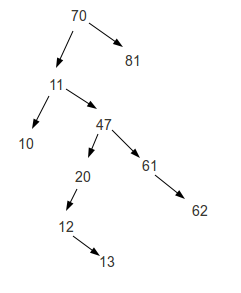
70, 11, 10, 47, 20, 12, 13, 61, 62, 81
10, 13, 12, 20, 62, 61, 47, 11, 81, 70
10, 12, 12, 13, 20, 47, 61, 62, 70, 81
It is in increasing order.
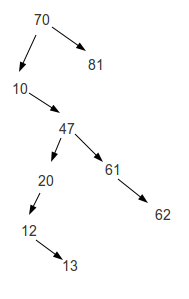
size that returns
the number of nodes in a binary tree.
public int size() {
  return size(root);
}

private int size(Node<E> root) {
  if (root == null)
    return 0;
  else
    return 1 + size(root.left) + size(root.right);
}
  public E mystery() {
      Node curr = root;
      while (curr.right != null)
         curr = curr.right;
      return curr.data;
  }
This returns the largest node in the tree by going all the way to the right.
mystery method above (other than the
obvious that root must refer to a binary search tree).
The tree should not be empty otherwise curr.right
results in a null reference exception.
find method for our BinarySearchTree
class binary search not using recursion but using
a loop.
public E iterative_find(E data) {
    Node curr = root;
    if (curr == null)
      return null;

    while (curr != null)
      if (data.compareTo(curr.data) < 0)
        curr = curr.left;
      else if (data.compareTo(curr.data) > 0)
        curr = curr.right;
      else
        return curr.data;

    return null;
}
Here's a few ways to think about. You could just apply the formula and get $log_2(403)=8.65$. Since height must be integral the the height must be 9.
The other way to think about it is that a tree of height 1 has at most 1 node, 2 has at most three nodes, 3 has at most 7 nodes, $n$ has at most $2^n-1$ nodes. So a tree of height 8 has at most 256 nodes. Then 9 has at most 512 nodes. And 403 is between 256 and 512 so it miust be 9.
That would be a degenerate tree and it would have height 403.